Showing posts with label Manga and Anime. Show all posts

Bringing Fantasy to Reality – Cosplay (コスプレ)


Hello, my dear readers! Let me ask you a question: have you ever taken a stroll down Harajuku (原宿) on a Sunday before? If so, was there ANYTHING in particular there that might have sort of caught your attention more than everything else?

Oh, wait a minute…do you know where on Earth Harajuku is? Have you ever heard of this place before? Well, I’m sure some of you have, though you may not be sure what exactly is so special about this place. Interested to know? Read on to find out!


To the common passer-by or tourist, especially for a non-Japanese, the sight of guys and girls dressed up in elaborate eye-catching costumes and colourful hair in the streets of Harajuku might be something bizarre that they don’t see every day. Stylish butlers, cute maids with little cat ears, sword-wielding samurais, staff-wielding mages, guitar schoolgirls, royalties and aristocrats of Europe’s past, Lolita fashion, and the list goes on – such are what one would commonly see adorning the streets and walkways of Harajuku on a typical weekend. Some think that they are silly, while others think that they reflect creativity at work amongst modern youths.

But for the typical anime/manga fan, they are undoubtedly part and parcel of today’s Japanese popular culture, something inseparable from the world of animes and mangas. And this particular “bizarre” sub-culture of Japan is widely known as “cosplay.”

A common sight in Harajuku, Tokyo on a typical weekend - cosplayers dispersed amongst non-cosplayers in public

It is not only in Harajuku, Tokyo’s cosplay capital, where one gets to see such creativity (or silliness) at work amongst today’s youths. Just pop into any typical anime/manga convention in your locality and you’re almost sure to see people donned in elaborate and colourful costumes with unnatural hair colours wielding intricately designed props while strutting around the convention grounds. If you have never been to one, you might perhaps have seen at least one or two of such people in the train or bus heading for a local anime/manga convention. Or you might have seen some of them walking around anywhere near the venue of an anime/manga convention. Whatever it is, it is extremely rare to see cosplay at work in public places outside Japan, so if you do see cosplayers in public on a typical day, chances are that there is an anime/manga convention going on somewhere nearby.

So, having given you a brief insight of this unique element of modern youth culture, some of you may now be expecting me to explain what exactly does the term “cosplay” mean. Well, if you are an anime/manga fan or are familiar with Japanese popular culture, then this term needs no introduction anymore. Nevertheless, for the benefit of those out there who may still be wondering as to what exactly this term entails, I will give you a brief introduction and definition here.

"Prepare for trouble!" "And make it double!"
Cosplayers portraying Jesse and James of Team Rocket from the hit anime series Pokémon

Cosplay (コスプレ, Kosupure), as the title above suggests, is basically about bringing fantasy into reality. Being a short form for “costume play,” it is a unique form of performance art in which people dress up and act as characters derived mainly from, but not exclusive to, animes, mangas, games, dramas, fantasy movies and comics. Because of its exceptional popularity in certain parts of Japan and in anime/manga conventions, however, cosplay has become somewhat synonymous with dressing up and acting out the roles of characters derived from animes, mangas/comics and Japanese-based games (ACG). As such, it is generally fair to say that every cosplayer is an ACG fan, but not every ACG fan is a cosplayer. Cosplaying is a passion and pastime that only a portion of the ACG fandom indulges in, as it can be very tedious, time-consuming and expensive.

Have you ever seen this popular couple being cosplayed before?
Cosplayers portraying Cloud Strife and Tifa Lockhart of Final Fantasy VII, two of the most popular favourites amongst cosplayers

The origins of this unique form of art and hobby remain vague even up to now. Contrary to popular belief, cosplay may not have been an intrinsically Japanese thing, and even today, there is no shortage of Japanese people who themselves are of the opinion that cosplaying is silly. Nonetheless, because cosplaying has become so popular in Japan, and because this hobby is often associated with ACG-themed characters, it is now often branded as a Japanese product marketed to tourists as an element of the country’s youth sub-culture.

Prior to the advent of cosplay in Japan, this unique form of performance art has been widely popular in America for several decades since the first half of the 20th century. It was, and is still, a popular practice for fans attending science fiction conventions to come dressed in futuristic apparel, mimicking characters from famous science fiction films. Apparently, the first known people to have started off this trend were Forrest Ackerman (1916 – 2008) and his friend, Myrtle Jones, who startled the 180-odd attendees of the 1939 First World Science Fiction Convention in New York with their futuristic-themed costumes. This aroused much public attention and garnered much delight from the attendees, so much so that in science fiction conventions in the succeeding years, more and more people started to follow in the duo’s footsteps. The non-Japanese trend of cosplaying thus spread like wildfire amongst fans of science fiction throughout the U.S.

Cosplaying based on Western cartoon/comic characters, particularly those from Marvel Comics

Although the art of cosplaying had already hit the shores of Japan by the 1960s, it was not a very popular pastime, and neither did it receive much publicity. The term “cosplay” only came into existence after 1984 when Nobuyuki Takahashi (高橋信之, Takahashi Nobuyuki) (1957 – ) of Studio Hard (スタジオ・ハード, Sutajio Hādo) coined the term by combining the two English words “costume” and “play.” While attending the 1984 Worldcon (World Science Fiction Convention) in Los Angeles, Takahashi was greatly impressed with the costumes that the attendees wore. He subsequently wrote about it in Japanese science fiction magazines, introducing and popularizing the term “cosplay” in the process.

As the popularity of ACG and Japanese popular culture throughout the world shot up dramatically since the late 1980s, so too did cosplay. Cosplaying became an increasingly popular form of performance art and hobby for ACG fans both in Japan and throughout the world. With an ever-increasing number of ACG conventions and events worldwide, cosplaying is increasingly being publicized in the mass media and internet, and the number of ACG fans who venture into it as a pastime also increases by the day.

Cosplayers dressing up as the Vocaloid characters, namely (from left to right) Kagamine Len, Kaito, Hatsune Miku, Kagamine Rin and Meiko

Unlike normal theme dressing like what one wears to a themed party or a special occasion, cosplaying involves a more in-depth involvement into the character being portrayed. The precision to which a cosplayer mimics the details of an ACG character’s costume and props is not the only factor that determines a successful cosplay. For an ACG character to be successfully portrayed, the cosplayer has to also act, behave, walk and talk like the character. Sometimes, the usage of certain taglines, especially Japanese ones, which are frequently uttered by a particular character, adds to the effect of successfully cosplaying the character.

In terms of recreating a particular ACG character’s costume and props, attention must be given to the quality and details. For a successful cosplay, everything must be reproduced to the minutest detail, and materials used must also be suitable for the character and occasion. Depending on the character chosen, reproducing his/her costume and props may vary in difficulty and detail. For example, reproducing the costume of an ACG schoolgirl character (e.g. Yui Hirasawa of K-On! in school uniform) may not be as difficult as reproducing that of an ACG mage character (e.g. Yuna of Final Fantasy X), simply because a mage character’s costume and props would generally involve much more markings and symbols as compared to that of an ordinary schoolgirl character. Additionally, because many ACG characters are portrayed with unnatural hair colours, some cosplayers either resort to dyeing their hair to resemble their characters’ colours or simply wear wigs.

Which do you think is harder - cosplaying as (left) Yui Hirasawa of K-On! or (right) Yuna of Final Fantasy X?

Cosplayers frequently devote a lot of time, money and energy into their endeavours, so much so that cosplaying becomes a passion and pastime for them. They can either create the costumes and props themselves if they have the skills or commission part of or all of the job to professional tailors, craftsmen and artists. A simpler way of cosplaying is to buy readymade costumes and props from shops selling ACG-related merchandise, but cosplayers who take this easy way out are frequently criticized for their laziness and lack of quality. Serious cosplayers normally prefer to invest their own time and energy into completing their costumes with their own hands, as it gives them a sense of satisfaction and achievement upon completion. Because this hobby involves the use of lots of creativity, innovation and attention to detail, it can be hailed as a form of art in its own right, an art that in most cases only ACG fans know how to appreciate.
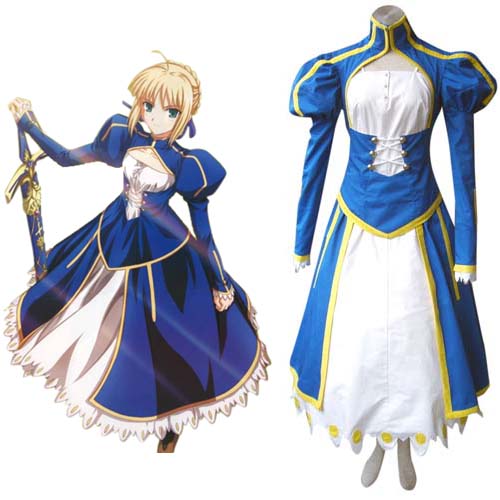
Good cosplaying requires close attention to costume details, even up to the very last dot and cutting, as seen in this design of the costume worn by Saber of Fate/stay Night

So, where do cosplayers normally choose to show off their hard work to the public? The simplest choice is to do so at any anime/manga/games convention or event, as long as there are no bans on cosplaying. Indeed, such events normally do not ban their attendees from cosplaying, and as far as I am aware of, only the annual Tokyo International Anime Fair (東京国際アニメフェア, Tōkyō Kokusai Anime Fea), which ironically is one of the largest anime events worldwide, has such a ban in effect. Some of these events, especially the larger ones, customarily organize cosplay competitions as part of their programmes. Such competitions may either require team or individual participation, and participants are normally required to perform a short sketch on stage before the public and the panel of judges. Participants are generally judged according to how accurately they imitate an ACG character’s costume and appearance, how they produced their costumes (i.e. purchased, commissioned or self-made), how well they act out the chosen character on stage, how entertaining their sketch is and how effectively they make use of stage space, props and technical equipment for their performance.

Skilled cosplayers showing off the results of their hard work during the 2010 Anime Festival Asia held in Singapore

Participants in the 2008 World Cosplay Summit (世界コスプレサミット, Sekai Kosupure Samitto) held in Nagoya, Japan

Besides anime/manga/games conventions and events, cosplayers may also choose to display their costumes and cosplaying skills in public places. Though being somewhat rare and unusual, there are some cosplayers who choose to wear their costumes in public and go on with their daily business as usual, even on a normal day. Such cosplayers do so out of their pride and love for cosplay. Nevertheless, in some places, particularly in Harajuku as I’ve mentioned earlier, cosplayers gather at specific locations at certain times of the week to flaunt their costumes and cosplaying skills in public.

Characters from the popular bishonen manga-cum-anime series Ouran High School Host Club being cosplayed

Another popular place where one can see cosplay at work is in a cosplay café (コスプレ系飲食店, Kosupure-kei Inshokuten), which is a themed café involving waiters and waitresses cosplaying as anime or manga-like figures. Such cafés normally adhere to a particular theme, the most popular being maid cafés (メイドカフェ, meido kafe) and butler cafés (執事喫茶, shitsuji kissa). As the names suggest, maid cafés typically involve waitresses dressed as French maids, while butler cafés employ waiters smartly dressed as butlers. Customers patronizing such cafés are treated as if they were returning back to their own mansion to be attended to by their team of personal maids and/or butlers. Indeed, customers are addressed politely as either Master (ご主人様, Go-shujin-sama) or Mistress (お嬢様, Ojō-sama). If you ever have the chance to, try entering a maid/butler café and you’ll be welcomed warmly with the greeting “Welcome home, Master, Mistress” (お帰りなさいませ、ご主人様、お嬢様, Okaerinasaimase, go-shujin-sama, ojō-sama). Alternatively, school-themed cosplay cafés are increasingly becoming popular, with such cafés reproducing the environment of a typical Japanese classroom and employing waiters and waitresses dressed in Japanese school uniforms. In such cafés, customers are addressed as Senior (先輩, Senpai) instead of Master and Mistress, giving customers a Japanese school feel reminiscent of that commonly seen in animes and mangas.

“Welcome home, Master, Mistress!” (「お帰りなさいませ、ご主人様、お嬢様」, "Okaerinasaimase, go-shujin-sama, ojō-sama")
Waiters and waitresses in a cosplay café dressed up as butlers and maids, ever ready to "welcome their masters and mistresses back home"

A maid serving her "master" in a typical maid café

No doubt, one can find a whole load of cosplay cafés by just taking a stroll down the streets of Akihabara (秋葉原), Tokyo’s anime capital. Although such uniquely-themed cafés originated from here in the late 1990s, their popularity has spread far and wide to many other parts of Japan and the world. Cosplay cafés may be found in countries and localities where a large anime/manga fanbase exists, and some may even be set up temporarily as part of an anime/manga convention.

Waitresses dressed as maids welcoming customers into their cosplay cafés in the streets of Akihabara, Tokyo

In the eyes of most non-ACG fans, cosplayers may seem like a bunch of fools doing loads of crazy stuff. They find it hard to understand why cosplayers are willing to spend so much time and money designing and producing such complicated costumes just to don them on during an ACG event. Due to the fact that cosplaying is indeed an expensive and “unusual” hobby, it is also not uncommon for some parents to perceive it as a frivolous waste of resources and an act of youth rebellion. Nevertheless, to the cosplayers themselves, as well as to ACG and Japanese pop culture fans, cosplaying is seen as a worthwhile and healthy pursuit. Besides keeping interested youths away from potentially unhealthy activities, cosplaying is seen to help promote one’s artistic creativity, acting skills and self-confidence.

Cosplayers portraying samurai characters from the renowned video game and anime franchise Sengoku Basara (戦国BASARA)

To sum it all up, cosplaying has indeed evolved over the past decades to become one of the most popular pursuits in the world of ACG fandom. The sight of people dressed in elaborate costumes, props and unusual hair colour frequently draws attention, curiosity and sometimes even raised eyebrows from the public, especially amongst those who are unfamiliar with the world of ACG and Japanese pop culture. It is this curiosity that has continuously attracted more ACG fans into the hobby, besides spurring the interest of popular mainstream media to help spread its popularity far and wide. Today, cosplay has undeniably become a worldwide phenomenon and success, and it is here to stay as long as animes, mangas, video games and Japanese pop culture remain popular.

Now, that's not a sight you see everyday! - Former President of Taiwan, Lee Teng-hui (Chinese: 李登辉, Lǐ Dēnghuī) displaying his hobby of cosplaying to the public by dressing up as Heihachi Edajima from the manga series Sakigake!! Otokojuku (魁!!男塾, lit. Charge! Men's Private School)

History of Manga (Part 1) (漫画の歴史)


Many of us love comic books, don’t we? I’m sure most of you reading this article are familiar with such titles as Spiderman, Iron Man, the X-Men and Captain America. OK, if you’re not really into comic books, then I’m sure you must have heard of these titles from movies instead. Regardless, these movies still have their origins in comic books.

Well, perhaps it might have been an overstatement for me to say that MANY of us love comic books. In fact, it might be more accurate for me to say that only a minority are really into comic books, most of whom are children or from younger age groups. Am I right in saying this? Well, not if you are in a country where trainloads of people, both young and old, both working and studying, can be seen having a comic book at hand and being absorbed into the depths of its contents.

And in this particular country, they call such comic books “manga.”

A normal sight in Japan - people in trains reading mangas

Yes, for fans of Japanese popular culture outside Japan, the term “manga” is no longer foreign. Alongside anime (Japanese animation), mangas have become an integral and inseparable part of Japanese popular culture fandom. In fact, many animes nowadays are actually adapted from mangas, so it is fair to say that without mangas, there would be no animes and thus, no Japanese popular culture fandom.

Anyway, for those of you who may be reading this article and are still not very familiar with what mangas are, let me explain further. Mangas are basically comics of Japanese origin, but the term may sometimes be used in a wider sense to refer to any comic that applies the distinctive Japanese style of comic art. Just like its animated counterpart, mangas today cover almost any theme and genre. Common themes covered include romance, crime and mystery, fantasy, mecha (robots) and science fiction, sports, school life and adventure. Of course, this list is not exhaustive. In fact, mangas are commonly utilized as a tool of education especially in Japan, in which subjects such as mathematics, physics and chemistry are frequently taught through mangas.

Fruits Basket (フルーツバスケット, Furūtsu Basuketto) - a shojo manga-cum-anime

While readers of mangas or comic books may only comprise a small minority in most parts of the world, it is the absolute opposite in Japan. As what someone once wrote online, manga readers come in all shapes and sizes in the Land of the Rising Sun. Just hop into a commuter train or bus anywhere in Japan and chances are that you would see someone (or many ones) being absorbed in a manga at hand. They can be as young as school-going children or as old as retirees. They can be clad in school uniforms, informal wear or even business suits. They can be male or female. Such is the popularity of mangas in this island-nation, and waves of it have reached the shores of almost every corner of the world.

Such is the popularity of mangas in the Land of the Rising Sun

So, how exactly then did mangas come into existence? If you’re a fan of mangas or Japanese popular culture, how well do you know the actual history behind this popular form of art? Did you know that one of the earliest mangas to have ever been produced dates back to almost a millennium ago? Or the fact that the mangas that we know today actually have their roots in Western comics rather than traditional Japanese art? Or the fact that mangas, just like animes, served as Japanese war propaganda during the Second World War? Read on to find out more for yourself!

Before I go on with the historical aspects of manga, let me first give you a contextual and working definition of mangas. The term “manga” (漫画) comprises two kanji, or Chinese characters, which respectively mean “lax” and “picture.” “Manga”, as one term, can be translated as “whimsical drawings,” and this term has been used for at least two centuries to describe comical drawings or images. To define what we would call a “manga,” we must first understand what “sequential art” is. This term basically refers to a story or event narrated by means of images, and often but not always texts, arranged in a sequence across a page. Manga is, therefore, a form of sequential art used to tell a vast variety of stories, particularly but not exclusively from the Japanese perspective.

A comic strip illustrating the concept of "sequential art"

The exact date or period as to when Japan produced its first manga is frequently disputed by historians and scholars. However, it is widely accepted that one of the earliest forerunners of Japanese manga are the picture scrolls produced by Toba Sojo (鳥羽僧, Toba Sōjō) (1053 – 1140), an artist-cum-Buddhist monk who lived during the Heian Period (平安時, Heian-jidai) (794 – 1185) of medieval Japan. Known as the Scrolls of Frolicking Animals or Choju Giga (鳥獣戯, Chōjū Giga) in Japanese, these humorous drawings illustrate various types of animals engaging in daily human activities. These drawings, which include amongst others frogs as priests losing their gamble, mischievous rabbits wrecking mayhem and monkeys engaging in farting contests, serve to parody the lifestyles of Japan’s upper classes and priesthood of the era.

A scroll from the Choju Giga (鳥獣戯, Chōjū Giga), depicting animals wrestling each other

These scrolls might arguably be one of the earliest mangas to have ever been produced, since they adhere to a sequential art format. Reaching as long as eighty feet per scroll and crossing from right to left, these scrolls made use of images arranged in a proper sequence across the scroll to narrate a story. There were also many other similar picture scrolls produced around Toba’s era and thereafter, some portraying religious messages and ghost stories in them and others parodying the lifestyles of humans. Most of these, however, were mainly confined to the viewership of the upper classes and priesthood at that time.

The development of ukiyo-e became the next major milestone in the history of Japanese art and manga. During the 16th and 17th centuries, ukiyo-e (浮世絵, lit. “Pictures of the Floating World”), a form of Japanese woodblock printing, developed and became a popular form of art. Ukiyo-e was frequently used to depict natural sceneries, historical events or everyday life during the Tokugawa Period (徳川時代, Tokugawa-jidai) (1603 – 1868), but most markedly, it was used to depict activities in the “floating world” of Yoshiwara (吉原), from which it derived its name. Yoshiwara was the red-light district and the centre of nightlife in Edo (江戸) (modern-day Tokyo) that provided escape and fantasy for rich clients by means of traditional theatres, teahouses, restaurants and high-class brothels.

An ukiyo-e painting of The Tale of Genji (源氏物語, Genji Monogatari)

Ukiyo-e, however, was not in any way directly associated with manga or sequential art during the earlier years of the Tokugawa Period. Instead, there were other forms of published drawings that resembled modern manga more during the same period. During the 18th century, Toba-e (鳥羽) became popular in cities such as Osaka, Kyoto, Nagoya and Edo (Tokyo). Toba-e, named after Toba Sojo himself, were books produced via woodblock printing which depicted everyday life using humorous caricatures, just like the scrolls produced by Toba. Simultaneously, akahon (赤本, lit. “Red Book”), which were children picture books with red front covers illustrating Japanese folktales, became popular amongst the general public. Akahon, which were either woodblock printed or hand-drawn, soon came to cover a larger variety of stories, some catering more for grown-ups.

A piece of Toba-e using humorous caricatures to illustrate everyday life

From akahon, other picture books of similar formats started appearing in subsequent years. Kurohon (黒本, lit. “Black Book”) and aohon (青本, lit. “Blue Book”), which were variants of akahon, came into existence and enriched the flourishing picture book businesses during the Tokugawa Period. In the later years of the Tokugawa Period, these picture books came to be known as kibyoshi (黄表紙, kibyōshi), which were essentially yellow-backed cover books depicting contents more suited for adult viewership, such as political satire, economic issues and philosophical ideals. Since kibyoshi mainly poked fun at the government, the powerful and the rich, they were soon after banned by the Tokugawa regime.

Contents of a kibyoshi published in the later years of the Tokugawa Period

As far as ukiyo-e is concerned, only the term “manga” has anything to do with it. Ukiyo-e was, is and has never been a form of sequential art, as it is used only to portray single scenes not connected to one another. It was the renowned ukiyo-e artist, Katsushika Hokusai (葛飾北) (1760 – 1849) who first coined the term “manga.” Published from 1814 to 1878, the Hokusai Manga (北斎漫画) is a 15-volume collection of block-printed sketches on various subjects drawn mostly by Hokusai himself. Although Hokusai decided to call his collection of works “manga” (which, as I’ve explained earlier, can be directly translated as “whimsical drawings”), they do not refer to manga in the same way as we understand it today, as they are not a form of storytelling sequential art.

The Great Wave off Kanagawa (神奈川沖浪裏, Kanagawa Okinami-ura), one of Katsushika Hokusai's most renowned ukiyo-e paintings

An excerpt from the Hokusai Manga

Prior to 1853, the entire island-nation was under an isolationist policy that tremendously limited Japan’s contact with the outside world. The entry of foreigners, especially Westerners, was strictly regulated and monitored under this policy. This stemmed from the fact that Catholic Christianity had spread extremely rapidly throughout Japan, especially in Kyushu, during the 16th and 17th centuries. The Tokugawa Shogunate, realizing that most Catholic missionaries present in Japan at that time were either Portuguese or Spanish, feared that their presence and work in Japan might soon cause the country to fall into either Portuguese or Spanish hands. As a result, the Tokugawa Shogunate enacted a series of policies from 1633 to 1639 to bring the entire country into isolation.

The arrival of Commodore Matthew Calbraith Perry (1794 – 1858) in Japan and the consequent opening of Japan to the world in 1853 was a turning point for the history of manga and Japanese history in general. With the use of threat and intimidation, the American naval fleet under Commodore Perry succeeded in prying open Japan’s closed doors to the world and opening its ports for Western trade. Through a series of unequal treaties signed between the Tokugawa Shogunate and several Western powers in subsequent years, Japan eventually saw an influx of Westerners residing in the country under extraterritorial rights.

Commodore Matthew Perry (1794 - 1858)

Indeed, the influx of Westerners into Japan brought with it an influx of Western culture and ideals, which greatly influenced every aspect of Japanese life, including the comic industry. Japanese comics would thus never be the same again, as it developed in a distinct direction that mixed the best of Western comic art and traditional Japanese aesthetics. Move on to the next part of this article to find out more about how mangas developed from after Japan’s opening to the world right up to the Second World War.

Main References:
(See last part)

Part 1 – the earliest forms of manga in Japan before Japan’s opening to the world in 1853
Part 2 – the manga industry from Japan’s opening in 1853 to the Second World War
Part 3 – the manga industry after the Second World War

History of Manga (Part 2) (漫画の歴史)


In the previous part of this article, you have read about the very beginnings of manga and its various primitive forms and precursors that existed prior to Japan’s opening to the world in 1853. Indeed, these “primitive” mangas, which grew in popularity over the centuries before Commodore Perry’s arrival in Japan, laid the very foundation upon which the later manga industry would grow and flourish. However, they were not the direct ancestors to today’s mangas, as that honour goes to Western comics instead, thanks to the influx of Western culture after 1853.

An artist's impression of Commodore Matthew Perry and the US Navy in Japan

After Japan’s opening to the world (and especially to the West), several ports were opened and developed for purposes of trading with the West. One of these was Yokohama (横浜), which saw its population of foreigners swell enormously over several years. Yokohama quickly became a bustling port-city of trade and commerce, and it soon became one of the largest settlements for Westerners in Japan.

Japanese painting depicting foreign ships docking at the flourishing port of Yokohama

With a growing population of Westerners in the port-city, it was natural that magazines and newspapers in foreign languages soon began publishing and circulating within the Western community. Charles Wirgman (1832 – 1891), an English cartoonist, started publishing The Japan Punch (ジャパンパンチ, Jyapan Panchi) in Yokohama in 1862. Modeled after a popular humour and cartoon magazine in London entitled Punch, The Japan Punch was an English magazine that featured much local news relevant to the Westerners, as well as humorous cartoon strips.

From its inception in 1862 right up to its termination in 1887, the magazine commanded a large readership not only amongst foreigners living in Yokohama, but also among the Japanese, especially those who were interested in Western culture. Consequently, cartoons in The Japan Punch became important sources of inspiration and influence for Japanese artists of the era, who then went on to experiment Western styles of cartoon drawing by fusing them with elements of ukiyo-e and other forms of traditional Japanese art. Resulting from these was a hybrid form of comic art, one which was distinct from conventional Western comic art and thus bore a uniquely Japanese identity. This new form of comic art was commonly dubbed panchi-e (パンチ絵), named after the magazine that inspired such work.

Cover of the April 1883 issue of The Japan Punch

Another Western magazine that played a major role in moulding the unique Japanese style of comic art was a French-style humour-cum-comic magazine called Toba-e. Published in Yokohama in 1887 by George Bigot (1860 – 1927), a French artist, this magazine ran for a period of three years and featured many cartoons that satirized the Japanese government and society of that time. In addition to The Japan Punch, Toba-e soon became another major source of inspiration for Japanese artists.

An excerpt from one of George Bigot's work as found in the magazine Toba-e

During the period when these magazines were actively running, Japan was undergoing a major overhaul in its political, economic and social structures. This period, known historically as the Meiji Period (明治時代, Meiji-jidai) (1868 – 1912), thus saw much growth in Japanese economic and political strength, but along with it came an increase in civil rights and political reform movements that resulted in the Freedom and People’s Rights Movement (自由民権運動, Jiyū Minken Undō). This mass movement which, amongst others, sought for a democratic establishment and the institution of civil rights, placed much pressure on the Meiji government and fought their purpose by means of comics.

With the widespread use of comics to propagate the movement’s ideologies, the Japanese comic industry continued to flourish and garnered much more popularity than ever. Many cartoon and humour magazines, modeled after The Japan Punch, were published by the Japanese and sold at affordable prices to the masses. One of these which deserves mention here is the Maru Maru Chimbun (団団), published in 1877 by Fumio Nomura (野村文, Nomura Fumio) (1836 – 1891). This magazine featured current news and comic drawings that poked fun at the government and the imperial household, and was thus able to propagate messages of reform and democracy that would otherwise result in prosecution under the law were they to be voiced out loudly.

Cover of one of the issues of Fumio Nomura's Maru Maru Chimbun (団団)

As the dawn of the 20th century came, comics continued to prosper throughout the island-nation, this time with a lesser political tone and an increasing appeal for children. Comic magazines catering for children mushroomed throughout the country, the most popular of which were Shonen Sekai (少年世界, Shōnen Sekai, lit. “The Youth’s World”), Shojo Sekai (少女世界, Shōjo Sekai, lit. “The Young Girl’s World”), Shonen Club (少年倶楽部, Shōnen Kurabu) and Shojo Club (少女倶楽部, Shōjo Kurabu). Both Shonen Sekai and Shonen Club, published from 1895 and 1914 respectively, catered more for young boys, whereas both Shojo Sekai and Shojo Club, published from 1906 and 1923 respectively, were tailored for young girls.

Cover of the January 1895 issue of Shonen Sekai (少年世界)


Of course, any discourse about the history of manga would not be complete without at least mentioning one of the two great founding fathers of modern manga. Nevertheless, since they lived and carved their names in stone during different eras, I will first be mentioning the earlier of the two in this part of the article. He is none other than Yasuji Kitazawa (北澤保次, Kitazawa Yasuji) (1876 – 1955), more commonly known by his pen name Rakuten Kitazawa (北澤楽天, Kitazawa Rakuten).

Rakuten Kitazawa was indeed a pioneer of manga during his time. Having travelled the world and acquiring extensive knowledge on comic art from various countries, especially the United States, he incorporated a new and vibrant form of art into his drawings that quickly rocketed him up to the pinnacle of fame. Many of his works integrated the best of both Western and Japanese comic art, thus creating a new and ingenious style that set the stage for mangas yet to come. Yes, Kitazawa wasn’t called the Father of Modern Manga just for nothing.

Kitazawa’s comics, which were greatly inspired by popular American comic strips such as The Yellow Kid by Richard Felton Outcault and The Katzenjammer Kids by Rudolph Dirks, went on to garner outstanding popularity and subsequently became a major source of motivation for many aspiring young artists. Many of his works, some of which were politically-themed, were published in Jiji Shimpo (時事) after he joined the daily newspaper in 1899. Some of his most famous works include Tagosaku and Mokube’s Sightseeing in Tokyo (田吾作と杢兵衛の東京見, Tagosaku to Mokubē no Tōkyō-kenbutsu) and The Failures of Kidoro Haikara (灰殻木戸郎の失, Haikara Kidorō no Shippai).

An excerpt from Rakuten Kitazawa's Tagosaku and Mokube's Sightseeing in Tokyo, a story first started in 1902 featuring two villagers going on sightseeing trips to Tokyo. Ignorant about city life, they embarrass themselves in foolish ways whilst in the capital


Besides working for Jiji Shimpo, Kitazawa also founded his own magazine in 1905, entitled Tokyo Puck (東京パック, Tōkyō Pakku). This was a monthly colour comic magazine that showcased the works of many Japanese comic artists, including his own refined and sophisticated style of drawing. Tokyo Puck became a tremendous hit that was translated into both English and Chinese and was also sold in Korea, Mainland China and Taiwan. Kitazawa’s works, which were at times cynical of the Meiji government, toned down and became more conservative after the infamous uncovering of an assassination plot against Emperor Meiji in the High Treason Incident (大逆事件, Taigyaku Jiken) of 1910.

Works of Rakuten Kitazawa as seen in the magazine Tokyo Puck. His drawings were widely admired for their uniquely refined and sophisticated styles

Alongside Kitazawa, there was also another comic artist who stood out among the many during that era. Ippei Okamoto (岡本一平, Okamoto Ippei) (1886 – 1948), after joining the Asahi Shimbun (朝日新聞) in 1912, was responsible for introducing the Japanese public to several American comics such as Bringing Up Father by George McManus and Mutt and Jeff by Bud Fisher. Besides bringing in these comics into the Asahi Shimbun newspaper, he also produced numerous comic strips which, like Kitazawa’s, involved a fusion of Western and Japanese styles of comic art. Okamoto was most credited for his renowned work The Human Life (人の一生, Hito no Isshō), as well as for being the founder of Japan’s first society for cartoonists, Nippon Mangakai (日本漫画会).

Ippei Okamoto (岡本一平, Okamoto Ippei) (1886 - 1948)

The ascension of Emperor Hirohito (裕仁) (1901 – 1989) to the throne in 1926, which thus marked the commencement of the Showa Period (昭和時代, Shōwa-jidai) (1926 – 1989), steered Japan into militarism, totalitarianism and ultranationalism. The Japanese government became more oppressive internally and aggressive externally, vying for more territorial control and political power in Mainland China and Asia as a whole. Indeed, the government’s tyrannical policies and military expansion rippled its effects onto every area of Japanese life, and the manga industry was no exception.

Emperor Hirohito (裕仁) (Reigned 1926 - 1989)

Doubtless to say, the manga industry became one of the earliest casualties of the oppressive regime, since it was formerly the main media used to satirize the government and spread anti-establishment sentiments. Speech and thought were tightly regulated and any comic artists who fell under suspicion of dissidence were either threatened or imprisoned. As Japan got ready to engage in warfare for Asian dominion, manga artists had only two choices: to produce propaganda manga for the military government, or to risk losing their jobs, be imprisoned or exiled.

Some, of course, chose to bow down to government pressure, while others fled the country for greener pastures overseas. When the Second World War erupted in 1939, manga, too, went to war, along with anime. As the Second World War saw the division of major powers into the Allied Forces and Axis Powers, so too were manga artists divided along those lines. Those who chose to remain and work for the government were either stationed locally to draw nationalist propaganda mangas for Japanese consumption, or were drafted to battle frontlines to draw propaganda mangas which were to be dropped amongst the local populace and the enemy lines. On the other hand, those who chose to leave Japan mostly ended up settling in Allied countries such as the United States, the United Kingdom and France, whereby some of them even decided to produce propaganda in favour of the Allied governments.

Involvement of Japan in the Second World War

Amidst wartime paper shortages, the Japanese military government supported the production of propaganda manga that instilled values of patriotism and willingness to sacrifice for the state and the emperor. Enemies were depicted in demonizing ways while Japanese soldiers in battle were given the highest glory. In order to encourage self-sufficiency amidst a time of scarcity, propaganda mangas were also used to teach the people how to be creative and inventive with whatever little resources that they had.

In the battle frontlines, manga artists were compelled to produce comics for the local populace that encouraged patriotism towards the Japanese emperor and government. In order to intimidate the Allied soldiers and undermine their morale, propaganda mangas that glorified Japanese superiority and military strength were mass-produced and were dropped in enemy lines. Creativity was stifled, papers for comics continued to be scarce, and mangas served no practical purpose except as propagandistic tools.

A propaganda manga produced around the war era depicting American President Theodore Roosevelt in a monstrous form

Perhaps one of the most notable mangas of the pre-World War II Showa Period that bore propagandistic elements to a certain extent was Norakuro (のらくろ) by Suiho Tagawa (田河水泡, Tagawa Suihō) (1899 – 1989). This humorous manga, which began publication in 1931, revolves around a black and white dog called Norakuro who serves as a soldier in an army of dogs that closely resembled the Imperial Japanese Army of the era. Although not explicitly propagandistic in nature, the manga did feature Norakuro taking up arms and fighting valiantly in the battlefield, all of which attempted to instill values of patriotism and sacrifice in the hearts of its readers.

An excerpt from the manga Norakuro (のらくろ) featuring a dog who serves in an army of dogs made to resemble the Imperial Japanese Army of the war era

On the side of the Allied Forces (in contrast to Japan that was part of the Axis Powers in the Second World War), propaganda manga drawn by Japanese artists also had a role to play. As mentioned earlier, some Japanese comic artists who refused to have their skills exploited by the government chose instead to flee to Allied countries, especially the United States. In their new countries, however, some chose to switch their allegiance to the Allied Forces and started drawing manga for their armies.

One such manga artist was the renowned Atsushi Iwamatsu (岩松淳, Iwamatsu Atsushi) (1908 – 1994), better known by his pseudonym of Taro Yashima (八島太郎, Yashima Tarō). Working for the U.S. Army during the Second World War, Yashima produced propaganda mangas which served to adversely affect the morale of Japanese soldiers in battle. One of these was The Unlucky Soldier (運賀無, Unganaizō), which featured a peasant soldier who died in the service of corrupt leaders.

Taro Yashima (八島太郎, Yashima Tarō), also known by his real name Atsushi Iwamatsu (岩松淳, Iwamatsu Atsushi(1908 – 1994)


It is often said that the first casualty of war is truth, but in the case of the Japanese society, creativity might well be the first casualty instead. During the Second World War, many manga establishments shut down and hardly any new mangas that did not in one way or another bear propagandistic elements appeared. In fact, with the war leaving Japan in hardcore poverty after the country’s unconditional surrender in 1945, the manga industry was virtually crippled and it was not until several years later that it was able to fully recover to full strength. With that, let us move on to the last part of this article.

Main References:
(See last part)