

“Here is a mantra, a short one that I give you. You may imprint it on your hearts and let every breath of yours give expression to it. The mantra is: ‘Do or Die.’ We shall either free India or die in the attempt; we shall not live to see the perpetuation of our slavery.”
When the voice of the great freedom fighter Mahatma Gandhi rang throughout the park of Gowalia Tank Maidan with those words on 8 August 1942, it swept across the entire nation of India like gushing fire, awakening and uniting its people at a degree unprecedented since the beginning of time. For perhaps the first time ever in India’s long and colourful history, people all over the land joined forces and in one voice echoed Gandhi’s own words to the British loud and clear: “Nothing less than freedom.”

The Quit India Movement (Hindi: भारत छोड़ो आन्दोलन, Bhārat Chhoṛo Āndolan), initiated by the Indian National Congress under the leadership of Mahatma Gandhi in 1942, was perhaps one of the greatest successes of the Indian people in forming a united front against British colonialism. It was a major movement that mobilized the entire nation as a single entity to put pressure upon the British government for immediate independence. And although some may have viewed it as a failure in several ways, the movement nonetheless gave the British a clear and concise indication – QUIT INDIA OR ELSE…
With the British declaring war against Germany in 1939 and the subsequent eruption of the Second World War, India was forcefully pulled into the war against its wishes, since it was a component of the British Empire. This angered the leadership of the Indian National Congress, as it was against all forms of war and supported peaceful means of fighting for goals under Gandhi’s satyagraha (Sanskrit: सत्याग्रह) principles of non-violent resistance. The Congress leadership condemned the British’s decision to drag India into the war without first consulting Indian leaders, but the British defended their decision by saying that waging the war was necessary to ensure world peace. The British also promised to secede more power to the Indians in return, of which Gandhi cynically reacted by stating that “The Congress has asked for bread and it has got stone.”

British soldiers at war during the Second World War
Support for the British from the Congress leadership and the Indians in general waned as the Second World War proceeded. Gandhi and the other Congress leaders were obviously displeased with India’s forced involvement in the war, and Indian cooperation with the British government deteriorated from bad to worse after the resignation of several Congress ministers in a few provinces in December 1939. The British government continued to adamantly defend their decision, while the Congress leadership under the great Mahatma persisted in showing their disapproval. All talks and negotiations came to a deadlock as both sides refused to give in to each other’s terms.
Nonetheless, amidst the raging war in Europe and several other parts around the world, the British were well aware of the pertinent need to secure Indian support and cooperation. India was Britain’s largest colony in Asia and the world, and it was a strategic commercial outpost and military bastion too precious to be lost especially in the face of Japanese militarism in Asia. By February 1942, the British had already lost Malaya (present-day West Malaysia) and Singapore into Japanese hands, and it couldn’t allow India to suffer the same fate as well.

British forces surrendering to the Japanese in Singapore after failing to defend both Singapore and Malaya from Japanese invasion
In order to mend the situation and improve relations with the Indians, the then British Prime Minister Winston Churchill (1874 – 1965) sent one of the ministers of his War Cabinet, Sir Richard Stafford Cripps (1889 – 1952) to initiate negotiations with Gandhi, the Congress leaders and Muhammad Ali Jinnah (Urdu: محمد علی حجنا) the leader of the Muslim League and later founder of Pakistan. Cripps was to encourage them to give public support for the British government and its war efforts. In return, Cripps pledged on behalf of the British government to increase Indian representation in the central government, establish a Constituent Assembly and grant India Dominion status, which would be nearly tantamount to full independence.

Mahatma Gandhi and Sir Richard Cripps sharing a light moment during the Cripps Mission
No doubt, these pledges sounded too good to be true, but they were indeed true to the word except for a single catch: they were only to be granted after the end of the Second World War. In other words, from Gandhi’s point of view at the time the pledges were made, they were only to be granted in the future, assuming that the British would emerge victorious in the War and at the same time retain India under its authority. But what worried Gandhi and the other Indian leaders more was the might of the Imperial Japanese Army that had already subdued almost all of East and Southeast Asia. The Japanese had already burned British authority in Malaya and Singapore to the ground, and they were now marching through Burma towards India.

Japanese troops crossing through Burmese villages towards India
To Gandhi and most of the Congress leaders, the British were too confident of their ability to defend India and emerge victorious in the War. The British, through Cripps, had made those pledges of self-governance with the confidence that they would still be in the position and authority over India to grant those pledges after the War. But what if the Japanese indeed proved to be mightier and ultimately annexed the entire Indian Subcontinent into its ever-expanding empire? Cooperating with the British would then spell disaster for India and its leaders, as the Japanese at that time were known to be pretty merciless towards any British sympathizers. Gandhi was in a dilemma, and he sarcastically likened Cripps’ pledges to “a post-dated check drawn on a crashing bank.”

Mahatma Gandhi and Muhammad Ali Jinnah (1876 - 1948)
Gandhi’s request to the British was clear and concise: “Nothing less than freedom”, and he wanted it immediately. He knew that the only way to save India was to ensure that it received the independence that it had long sought for without further delay. The Congress leaders, including Gandhi, did not want the British to defend their homeland against impending Japanese invasion for two main reasons.
Firstly, in the event of British defeat, the Congress leaders did not want the British forces to resort to destroying cities, industries and infrastructures in accordance with the “scorched-earth” policy as was practiced earlier on in Malaya and Singapore. (For your information, the “scorched-earth” policy, as was practiced by the British forces in Malaya and Singapore prior to their surrender to the Japanese, involved mass destruction of administrative buildings, cities and infrastructures, as well as important government documents, in order to slow down Japanese invasion and to make it more difficult for the Japanese to establish a new administration and economic structure in the region after taking over.)

The damaged Causeway connecting Johor Bahru, Malaya (Malaysia) to Singapore. It was severed and blown up by the British forces as part of the "scorched-earth" policy to slow down Japanese invasion
Secondly, Gandhi and the Congress leaders wanted to ensure that India and its leaders remained neutral in the War. To Gandhi, this was vital to show the Japanese and the world that India had neither sided nor cooperated with the British throughout the course of the War. Only then would Gandhi and the Congress leaders perhaps be able to negotiate favourable terms for independence and self-governance with the Japanese in the event that the latter succeeded in conquering India. Evidently, Gandhi had a strong premonition that India was about to fall into Japanese hands and was highly pessimistic about Britain’s chances of winning the War and retaining India.
The result of the negotiations between Cripps and the Indian leaders was utterly disappointing. Shortly after Cripps returned to Britain, Gandhi made a public call for the British to leave India peacefully or be chased out by means of non-violent resistance. His justification for such a stand was clear: “The presence of the British in India is an invitation to Japan to invade India. Their withdrawal removes the bait.” As a result of this call, the Indian National Congress met from 29 April to 1 May 1942 in Allahabad (Hindi: इलाहाबाद) and once again on 14 July 1942 in Wardha (Marathi: वर्धा) to pass the renowned ‘Quit India’ resolution demanding complete independence from the British.
The Quit India resolution received mixed response from Indian leaders. Chakravarti Rajagopalachari (Tamil: சக்ரவர்த்தி ராஜகோபாலாச்சாரி) (1878 – 1972), a prominent Congress leader from Tamil Nadu, quit the Congress out of disagreement with the resolution. Jawaharlal Nehru (Hindi: जवाहरलाल नेहरू) (1889 – 1964) and Maulana Azad (Urdu: مولان آزاد) were apprehensive of the resolution, but decided to support Gandhi’s stand to the end. Jinnah himself was also opposed to the resolution. Nevertheless, many others in the Congress were supportive of the movement.

Chakravarti Rajagopalachari (Tamil: சக்ரவர்த்தி ராஜகோபாலாச்சாரி) (1878 - 1972)
In spite of the mixed reactions that the Quit India resolution received from various quarters, support was generally widespread and strong. The Congress leadership met again on 8 August 1942 in Bombay (Mumbai, Marathi: मुंबई) to ratify the resolution and launch a nationwide campaign against the British. It was then that Mahatma Gandhi issued his renowned Quit India speech in the park of Gowalia Tank Maidan in central Bombay, urging the British to leave India immediately or be forced out of the country by mass resistance from the people. To repeat what the great Mahatma said during his inspiring speech:
“…I am not going to be satisfied with anything short of complete freedom. Maybe he (the British Viceroy of India) will propose the abolition of salt tax, the drink evil etc. But I will say, “Nothing less than freedom.” Here is a mantra, a short one that I give you. You may imprint it on your hearts and let every breath of yours give expression to it. The mantra is: ‘Do or Die.’ We shall either free India or die in the attempt; we shall not live to see the perpetuation of our slavery…”

(From left) Mahatma Gandhi, Maulana Azad and Jivatram Kripalani at the Congress' meeting in August 1942
The speech, however, did not impress the British. Just one day later, on 9 August 1942, the British government came down hard on the Congress leaders and supporters of the movement. Gandhi himself was apprehended and imprisoned in the Aga Khan Palace (Hindi: आगा खान पैलेस, Āgā Khāna Pailēsa) in Pune (Marathi: पुणे), along with his wife Kasturba Gandhi (Hindi: कस्तूरबा गाँधी) (1869 – 1944) and secretary. Other Congress leaders, such as Nehru, Azad and Sardar Vallabhbhai Patel (Gujarati: સરદાર વલ્લભભાઈ પટેલ) (1875 – 1950) also suffered the same fate and were imprisoned in the Ahmednagar Fort. The high committees of the Congress leadership were immediately outlawed and the assembly of public meetings prohibited.

Mahatma Gandhi in discussion with Sardar Patel and Maulana Azad
This turn of events did not go down well with the Indian masses. What Gandhi intended to be a peaceful non-violent civil disobedience movement against the British quickly erupted into massive violent protests throughout the whole nation. Mass demonstrations and strikes sparked throughout India in the few days following Gandhi’s imprisonment, demanding the release of the Congress leaders and independence. Government buildings, police stations, post offices and railway stations throughout the country were attacked, seized and set ablaze by the masses. Electricity supply, communication lines and railway tracks were severed, while workers held mass strikes that paralyzed much of the British economy in the subsequent months. Bombs were also thrown on the police and government buildings especially in Bombay, Madhya Pradesh (Hindi: मध्य प्रदेश) and Uttar Pradesh (Hindi: उत्तर प्रदेश). Additionally, huge numbers of students staged massive protests in places such as Bangalore (Kannada: ಬೆಂಗಳೂರು), Hyderabad (Sindhi: حيدرآباد) in Sind, Nagpur (Marathi: नागपूर) and Pune. Not one state or province in India, from the southernmost tip of the peninsula to the northern Himalayan mountains, saw peace or order throughout the course of the civil disobedience movement.
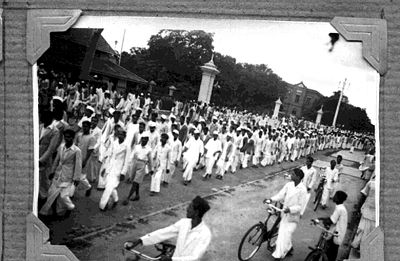
Quit India processions in Bangalore, Karnataka

Huge crowds gathering at Gowalia Tank Maidan on 9 August 1942, the day Gandhi and the other top Congress leaders were imprisoned
One of the most violent and notable uprising that took place during the Quit India movement occurred in Ballia (Hindi: बलिया), Uttar Pradesh. Mass protests and civil disobedience resulted in the overthrowing of the district administration, the breaking open of jails and the release of arrested Congress leaders. In fact, the protesters actually succeeded in establishing their own independent rule for several weeks before the British could get their hold on the district again. Similarly, Indian leaders succeeded in severely destabilizing British administrations in several cities and provinces, setting up independent parallel governments to challenge British authority.
The British did not hesitate to take drastic and draconian action against the masses. Over 100,000 people were arrested nationwide and mass fines were imposed on countless individuals. Many of those arrested, especially students, were publicly flogged in several major cities in India. During several occasions, the British also resorted to opening fire from air against protesters, resulting in the death of many, including women and children. In several less violent attempts to diffuse crowds of protesters, tear gases were employed instead.

Women taking part in processions against the British in Bombay, Maharashtra
Indeed, the Quit India movement was so large and widespread that it took the British nearly two years before they could restore order and peace in India. Official records released by the British stated a total death toll of 1028 during the Quit India movement, but Nehru estimated the death toll to be anywhere between 4000 to 10,000. The entire movement that fully ended only by early 1944 created enough pandemonium to open the eyes of the British to India’s reality. General Robert Lockhart (1893 – 1981), the general of the British Indian Army during the Second World War, was so taken aback by the course of events in India that he subsequently came to recognize the country as an “occupied and hostile country” instead of just a colony. Prime Minister Churchill himself also came to recognize that independence for India was going to be an inevitability in due time, as the Indians had made an obstinate stand that they no longer wanted the British on their land.
Due to health reasons, Gandhi was released in May 1944 before the end of the Second World War. His wife and secretary, however, had passed away while still under imprisonment, much to the sadness of the Congress leaders and the people of India. On the other hand, Patel, Azad, Nehru and the other imprisoned Congress leaders were only released about a year later, in June 1945.

The Aga Khan Palace (Hindi: आगा खान पैलेस, Āgā Khāna Pailēsa), the site of Gandhi's imprisonment after his controversial Quit India speech
The Quit India movement was initially viewed as a failure by many Congress leaders, since it took a violent course that departed from Gandhi’s principles of satyagraha and non-violent resistance. Nonetheless, it was later perceived in a more positive light in the sense that it had united the whole of India under a common purpose against British colonialism. Never before had this nation of millions seen such solidarity that brought its citizens of different religions and languages together under one roof and one goal. Indian nationalism was reinforced and Indian oneness reaffirmed. The movement soon after became a catalyst for India’s independence, as it got the British machinery working towards granting full self-governance to the people of India.

Indian stamp commemorating the Quit India movement, portraying Mahatma Gandhi and Jawaharlal Nehru in the Congress' August 1942 meeting in Bombay


