Showing posts with label General Knowledge. Show all posts

History of Chess (Part 1)


What do you think the three things above have in common? Any ideas?

No doubt they are all board games, and popular are they too. But that’s not the only similarities that the three of them share. Any other ideas as to what they may possibly have in common?

For some of you out there, it may be unfair for me to ask any further, as you might be giving the right two photos above perplexed stares, wondering at the back of your minds as to what exactly they may be. Whatever it is, I’m very sure that most of you would be able to recognize the first photo from the left as being that of conventional Western chess, or what most of us would normally refer to simply as “chess.” Well, did you know that there are also other existing types of chess in this world, such as Chinese chess (Chinese: 象棋, xiàngqí) and Japanese chess (Japanese: 将棋, shōgi)? As some of you might already be aware of, these two types of chess are portrayed respectively in the right two photos.


So, let us get back to the question above. What do you think the conventional Western chess, Chinese chess and Japanese chess have in common? Might it be their rules? Or the alignment of their component pieces on the board? Or perhaps their historical origins?

Before I give you the answer, perhaps it may be best for me to give you an overview of the rules for each of these three popular types of chess. Then perhaps you may be able to compare and contrast for yourselves the similarities and differences between them. On top of that, in order to better understand the origins and progression of chess throughout history, it would be best if you first understand the basic rules of these three types of chess. If, however, you do not wish me to bore you with all these facts and descriptions, feel free to move straight to the next part of this article.

Conventional Western chess


Conventional Western chess, or what people always refer to as “chess” in English, is perhaps one of the most widely played board games in the world, having spun numerous national and international tournaments revolving around the game. Basically, Western chess is played on an 8-by-8 square board, giving a total of 64 squares with alternating colours, as seen in the diagram below. The game is played by two opposing players, each commanding a set of 16 pieces coloured black and white respectively. Each player begins with one king, one queen, two rooks (castles), two bishops, two knights and eight pawns (soldiers). The arrangement of the pieces is shown below.

 Arrangement of pieces at the start of the game in conventional Western chess

The player commanding the white set makes the first move. At any one turn, players can only move a single piece, either to an unoccupied square or to a square occupied by the opponent’s piece. In the latter case, the opponent’s piece is captured (“eaten”) and removed from the chessboard. The only exception to this is the en passant rule, which I will explain later. Although players are only allowed to move one piece at a time, an exception applies if the player chooses to do castling, which I will also explain later. The objective of the game is to render the opponent’s king helpless, thus putting the king under “checkmate.” A player’s king is considered checkmated if the opponent’s next move will result in its capture and it is unable to move anywhere else to avoid capture.

"Checkmate!" The black king is checkmated as the white piece's next move will result in its capture and it is unable to move anywhere else to avoid capture

The game is considered over if either one of the player’s king is checkmated or stalemated. In the case of stalemate, the king is itself under no direct threat from any piece, but the player is unable to make any legal moves to avoid capture in the next turn. Unlike checkmate, a stalemate results in a draw (i.e. having no winner) between the two players, and is sometimes used as a tactic to avoid losing to the other player, especially in professional tournaments.

A case of stalemate. The black king is under no direct threat of capture from any white pieces, but itself cannot move anywhere else in its next turn to avoid capture

Each chess piece is allowed to move only in its predetermined style. This is listed below, and illustrated in the following diagrams:

1.    King: Moves one square in any direction. Can also move in conjunction with the rook (castle) in a move called “castling.”
2.    Queen: Moves in any direction and with any number of squares. It cannot, however, leap over other pieces.
3.    Bishop: Moves diagonally only with any number of squares. It cannot leap over other pieces.
4.    Rook (castle): Moves horizontally or vertically only with any number of squares. It cannot leap over other pieces. Can move in conjunction with the king during “castling.”
5.    Knight: Moves in an “L”-shape, that is two squares vertically and one square horizontally or two squares horizontally and one square vertically. It is the only piece allowed to leap over other pieces.
6.    Pawn (soldier): Has several moves. It can move forward to an unoccupied square immediately in front of it (i.e. moves one square to the front vertically provided the square is empty) or to an occupied square diagonally in front of it (i.e. moves one square to the front diagonally provided the square is occupied), thus capturing the occupying piece. On its first move, a pawn may also advance two squares vertically forwards provided both squares are empty. A pawn can only move forwards until it is promoted. It has two special moves i.e. the en passant capture and the pawn promotion.

Under no circumstances can a player capture his or her own pieces.
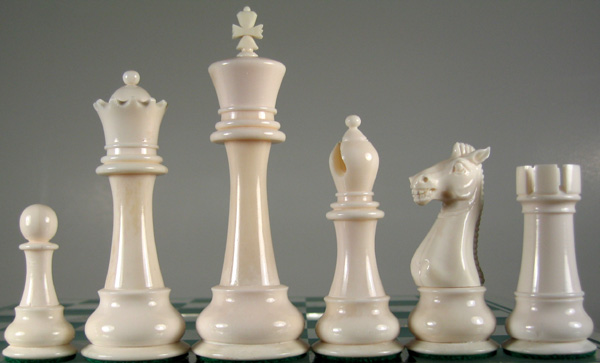
Conventional Western chess pieces. From left: Pawn, queen, king, bishop, knight and rook

Castling is a special move in which the king moves two squares horizontally towards a rook (castle) and the rook (castle) moves to the last square the king crossed. Each player can only do it once in every game, and certain conditions have to be met, namely:

1.    Both the king and the rook (castle) have not been previously moved during the game (i.e. both these pieces still remain in the same positions from the start of the game)
2.    There must be no pieces between the king and the rook (castle)
3.    The king must not be in check (under direct threat of capture from any opponent piece), nor may it pass through any square that is under attack from opponent pieces, nor move to a square that would put it under check

 Castling

En passant is another special move in chess, involving the pawn. When a pawn advances two squares forward from its initial position in the game and it lands directly beside the opponent’s pawn, the latter can capture it en passant (in passing) by moving to the square that the former passed over. This can only be done on the very next move; otherwise the right to do so is lost. This move is illustrated in the diagram below.

 En passant

Pawn promotion occurs when a player’s pawn reaches the furthest row away from the player (i.e. the opponent’s first row). A pawn can thus be exchanged for the player’s choice of any piece of the same colour. There is no restriction for the piece that can be chosen for promotion, thus it is possible for a player to have more pieces of the same type compared to at the start of the game (e.g. two queens).

Chinese chess


Chinese chess (Chinese: 象棋, xiàngqí) is a popular board game in China and in areas with large Chinese populations worldwide. Its name in Chinese literally means “elephant game”, an allusion to the “elephants” or bishop-equivalents in the game. Chinese chess is different from Western chess in several aspects, one of which is its board. The board used in Chinese chess has 9 vertical lines and 10 horizontal lines, and the pieces are played on the intersections of these lines. Between the 5th and 6th horizontal lines, separating the two opposing sides, is a river that is often marked as the Chu River (楚河, Chŭhé) and the Han Border (漢界, Hànjiè), a reference to the historical Chu-Han War (楚汉相争, Chŭhàn Xiāngzhēng) of 206 – 202 BC.

In its most common form, Chinese chess is played by two opposing players, each commanding a set of 16 pieces coloured red and black respectively. Each player begins with one general, two advisors, two elephants, two horses, two chariots, two cannons and five soldiers. The arrangement of the pieces at the beginning of the game is shown below.

 Arrangement of pieces at the start of the game in Chinese chess. Note the Chu River/Han Border (楚河漢界) at the centre separating the two opposing sides

Throughout history, there has not been a single definite rule as to who makes the first move. Even today, some guidebooks state that the black side moves first, while others state that the red side moves first. In many tournaments today, however, the red side is normally given the chance to move first. Like Western chess, players can only move a single piece at any one turn, either to an unoccupied point or to a point occupied by the opponent’s piece, thus capturing and removing the opponent’s piece from the board. Unlike Western chess, however, there is no pawn (or soldier) promotion, thus a captured piece can never be returned back to the chessboard. The objective of the game is similar to Western chess, that is to render the opponent’s general helpless, thus putting it under “checkmate” (将死, jiāngsǐ).

Another different point about Chinese chess is that when a stalemate occurs, the player with no legal moves left loses. In order to avoid losing, a disadvantaged player may end up checking or chasing pieces in a way that the moves fall into a repeated cycle. In such situations, special rules exist to draw the game. As these rules differ from place to place and are somewhat confusing, I will not delve into them here.

 Painting depicting Chinese chess being enjoyed as a popular pastime in imperial China

Some pieces move in the same manner as their corresponding pieces in Western chess, while others move in a slightly different manner. There are also several additional pieces in Chinese chess which are absent in Western chess. The pieces in Chinese chess are as follows:

1.    General: Labelled / (jiāng, lit. general) on the black side and / (shuài, lit. marshal) on the red side. It can only move and capture one point forwards, backwards or sideways in a horizontal or vertical fashion. Its movement is limited to within the palace (the squares with the diagonal lines) only. Its capture results in the end of the game and the defeat of the captured general’s player. Although its movement is limited to within the palace, there is an exception to this: when a general faces the opposing general directly in the same row without any pieces in between, the “flying general” (飞将, fēi jiāng) move can be done, enabling the player’s general to “fly” directly to the opposing general’s palace to capture it. The general is the king-equivalent in Chinese chess.
2.    Advisor: Labelled (shì, lit. scholar/official) on the black side and (shì, lit. scholar/official) on the red side. Starting beside the general, the two advisors can only move and capture one point diagonally within the palace.
3.    Elephant: Labelled (xiàng, lit. elephant) on the black side and (xiàng, lit. minister) on the red side. They are, however, generally known as elephants. The two elephants can only move and capture exactly two points diagonally. They cannot jump over any piece, neither can they cross the river. They roughly correspond to the bishops in Western chess.
4.    Horse: Labelled / (, lit. horse) on both sides in most modern sets. The horse moves and captures in an L-shape, similar to the knight in Western chess. However, unlike the knight in Western chess, the horse is supposed to move two points vertically or horizontally first, followed by one point horizontally or vertically respectively. In other words, the horse is supposed to move the long arm of the “L” first, followed by the short arm. If a piece lies at the centre of the long arm of the “L”, the horse’s movement is obstructed, as illustrated below.
5.    Chariot: Labelled / (, lit. chariot/car) on both sides in most modern sets. It moves and captures any number of points horizontally or vertically, but it cannot jump over any pieces. It is the exact equivalent of the rook (castle) in Western chess.
6.    Cannon: Labelled (pào, lit. cannon) on the red side and (pào, lit. catapult) on the black side. In English, both are normally referred to as cannons. The cannons move any number of points horizontally or vertically, just like the chariot, but it can only capture another piece by jumping over a single intervening piece (ally or enemy). It cannot jump over a piece and not capture anything, neither can it capture without jumping.
7.    Soldier: Labelled (bīng, lit. soldier) on the red side and (, lit. pawn/private) on the black side. Soldiers move and capture by advancing one point forwards only before they cross the river. Once they cross the river, they can move and capture one point forwards or sideways. They cannot move backwards, and upon reaching the last row on the board, they can only move and capture sideways. Unlike the pawn in Western chess, they cannot be promoted.

Pieces in Chinese chess. From left (top and bottom respectively): General, advisor, elephant/minister, chariot, horse, cannon, soldier/pawn

Japanese chess


Although there exists several types of chess in Japan, Japanese chess (Japanese: 将棋, shōgi) is perhaps the most popular one. Its Japanese name literally means “general’s chess.” It is played on a board containing 81 rectangles, 9 in each column and 9 in each row. These rectangles are undifferentiated by marking or colour.

Whereas pieces in both Western and Chinese chess are differentiated between the two opposing sides by their colours or markings, this is not the case with Japanese chess. In Japanese chess, corresponding pieces on both sides contain the same colour and markings, with the exception of the kings. In order to tell apart as to which pieces belong to which side, one has to look at the orientation of each piece. Each piece is wedge-shaped and has a protruding end that points towards the opponent during the game.

Each player starts with 20 pieces, comprising a king, a rook (castle), a bishop, 2 gold generals, 2 silver generals, 2 knights, 2 lances and 9 pawns. These English names are standardized names used in English translations of the game, and do not necessarily reflect their actual meanings in Japanese. The role played by each piece is marked in Japanese characters on the top side. In all pieces except the king and gold generals, Japanese characters are also found on the bottom side. These may sometimes be marked in red, and they indicate the roles played by the pieces once they are promoted. The bottom side is turned face up once a piece undergoes promotion. The arrangement of the pieces before the start of the game is shown in the picture below.

 Arrangement of pieces at the start of the game in Japanese chess

The game starts when either player makes the first move. Similar to Western chess, a player can move only a single piece in any one turn. The piece can be moved to an empty rectangle or to one that is occupied by an enemy piece, thus capturing and removing it from the board. Alternatively, a player may choose to use his turn to “drop” a captured piece onto the board. The “drop” rule is a special rule that is unique to Japanese chess alone. I will explain more about this later. Players can only capture opponent pieces and not ally pieces.

Pieces in Japanese chess move in their predetermined fashion, some similar to Western and Chinese chess and others different. They are described below:

1.    King: Labelled (ōshō, lit. king-general) or (gyokushō, lit. jeweled general). It can move only one rectangle in any direction. It cannot be promoted.
2.    Rook (castle): Labelled 飛車 (hisha, lit. flying chariot). Similar to the rook (castle) in Western chess and the chariot in Chinese chess, it can move any number of rectangles horizontally or vertically, but it cannot jump over any pieces.
3.    Promoted rook (dragon): Labelled (ryūō, lit. dragon king) in cursive. It is promoted from the rook (castle). It can move as a rook (castle) or as a king, that is, it can move any number of rectangles horizontally or vertically, or only one rectangle diagonally, but not both during any one turn. It cannot jump over any pieces.
4.    Bishop: Labelled 角行 (kakugyō, lit. angle mover). Similar to the bishop in Western chess, it can move any number of rectangles diagonally, but it cannot jump over any pieces.
5.    Promoted bishop (horse): Labelled 龍馬 (ryūma, lit. dragon horse) in cursive. It is promoted from the bishop. It can move as a bishop or as a king, that is, it can move any number of rectangles diagonally, or only one rectangle horizontally or vertically, but not both during the same turn. It cannot jump over any pieces.
6.    Gold general: Labelled (kinshō, lit. gold general). It can move one rectangle vertically forwards or backwards, or one rectangle horizontally sideways. It can also move one rectangle diagonally forwards, but cannot move diagonally backwards. It cannot be promoted.
7.    Silver general: Labelled (ginshō, lit. silver general). It can move one rectangle diagonally forwards or backwards, or one rectangle vertically forwards. It cannot move vertically backwards or horizontally sideways.
8.    Promoted silver: Known as 成銀 (narigin, lit. promoted silver), but marked on the pieces as a cursive variant of (kin, lit. gold) or . Promoted from the silver general, it replaces the power of the silver general with that of the gold general.
9.    Knight: Labelled 桂馬 (keima, lit. cassia horse). Like the knight in Western chess, it moves in an “L-shape” fashion, but its difference is that it can only move forwards and not sideways or backwards. As such, it can only move two rectangles vertically forwards and one rectangle horizontally, forming an “L-shape” to the front. Unlike the horse in Chinese chess, its movement is not blocked by intervening pieces, as it is the only piece on the board that can jump over pieces.
10.  Promoted knight: Known as 成桂 (narikei, lit. promoted cassia), but marked on the pieces as a cursive variant of (kin, lit. gold), or . Promoted from the knight, it replaces the power of the knight with that of the gold general.
11.  Lance: Labelled 香車 (kyōsha, lit. incense chariot). It can move any number of rectangles vertically forwards only. It cannot move backwards or sideways. It cannot jump over any pieces.
12.  Promoted lance: Known as 成香 (narikyō, lit. promoted incense), but marked on the pieces as a cursive variant of (kin, lit. gold), or . Promoted from the lance, it replaces the power of the lance with that of the gold general.
13.  Pawn: Labelled 歩兵 (fuhyō, lit. foot soldier). It can only move and capture one rectangle vertically forwards and cannot move backwards, sideways or diagonally.
14.  Promoted pawn: Known as と金 (tokin, lit. reaches gold), but marked on the pieces as a cursive variant of (kin, lit. gold), or . Promoted from the pawn, it replaces the power of the pawn with that of the gold general.

 Pieces in Japanese chess. From left (top): Promoted bishop (dragon horse), bishop (angle mover), king/general, king/general, rook (flying chariot), promoted rook (dragon king), gold general. From left (bottom): Promoted pawn, silver general, promoted silver, knight/horse, promoted knight, lance (incense chariot), promoted pawn, pawn/foot soldier

Promotion can be done when a player’s piece either moves into, out of or wholly within the promotion zone. The promotion zone is the furthest three rows on the board, that is, the three rows occupied by the opponent’s pieces at the start of the game. A player may choose to promote a piece at the end of his turn after moving the particular piece, or he may choose to let the piece remain unpromoted. Promotion is indicated by turning the bottom side of the piece up, revealing the Japanese characters marking the promoted piece’s rank. A piece deliberately “dropped” within the promotion zone cannot be promoted immediately, but only in subsequent turns. Promotion of a piece remains permanent until the piece is captured, after which it reverts back to its initial rank.

A special rule that is unique to Japanese chess is the “drop” rule. When a piece is captured, it is not “eaten,” as is frequently said in both Western and Chinese chess. A captured enemy piece is retained in the capturing player’s hand and can be returned into play at any turn under his/her control. After dropping, the captured enemy piece becomes part of the capturing player’s forces i.e. it switches sides. Dropping takes a whole turn of its own i.e. after dropping, the player cannot move any other piece and his turn ends. Dropping a piece within the promotion zone does not result in immediate promotion, and neither can a piece be dropped on an occupied rectangle to capture an enemy piece. It can only be dropped into an empty rectangle.

Two restrictions apply to dropping pawns. Firstly, a pawn cannot be dropped onto the same column as another unpromoted pawn controlled by the same player. Secondly, a pawn cannot be dropped to give an immediate checkmate, although other pieces can be dropped to do so.

 Former World Chess Champion, Garry Kasparov, trying his hand in a game of Japanese chess

Similar to all other types of chess, the objective of Japanese chess is to render the opponent’s king helpless, thus putting it under “checkmate” (詰み, tsumi). A game may end with a draw if the same game position occurs four times with the same player or if the game reaches a stalemate. A stalemate occurs if both kings have advanced into their respective promotion zones and neither player can hope to attack the opponent’s king or gain any further material by capturing more pieces. A stalemate has to be agreed upon by both players, after which a point calculation system based on all the pieces in a player’s possession is used to determine the game’s outcome.

Shion no Ou/The Flowers of Hard Blood (しおんの王), a mystery-themed manga-cum-anime based on the game of Japanese chess

Having given you a brief and concise outline of the basic rules and layout of Western, Chinese and Japanese chess, let us now move on to the next part of this article.


*Contents of this article:
1.      Part 1 – Introduction to the basic rules of chess
2.      Part 2 – Early history of chess
3.      Part 3 – History of chess in medieval Europe
4.      Part 4 – Modern history of chess

History of Chess (Part 2)


So, after reading about the basic rules and layout of Western, Chinese and Japanese chess in the first part of this article (if you did read them at all), did you realize any striking similarities between them?

Doesn’t it seem too much of a coincidence that the three different types of chess have so much in common? Isn’t it weird that in all the three types of chess,

1.    the king or general always starts off at the middle of the first row?
2.    the king or general is clamped on both sides of the first row by identical pairs of pieces?
3.    a game is won by checkmating the king or general i.e. the “chief” piece of the game?
4.    a rook (castle) or chariot always lies at the furthest ends of the first row?
5.    the rook (castle) or chariot can only move in a vertical or horizontal direction?
6.    a knight or horse always lies in the second furthest column at both ends of the first row?
7.    the knight or horse always moves in an “L-shape”?
8.    there exists the bishop or bishop-equivalent (e.g. elephant, angle mover), whereby such pieces move in a diagonal fashion only?
9.    there exists pawns or soldiers arranged in the most numbers in the front-most row at the start of the game?
10.  the pawns or soldiers cannot move backwards?

Isn’t it too much of a coincidence that the Europeans have been playing their own version of chess for many centuries even without realizing that their counterparts in the Far East (i.e. China, Korea and Japan) were also doing the same all along? Isn’t it strange that for many centuries, the Chinese, Koreans and Japanese have been moving their chess pieces in a manner largely similar to that of their European counterparts even without realizing it? Don’t all these seem too much to be merely a coincidence?


All these similarities can only point towards one direction – the three different types of chess aren’t altogether that different after all. They have a common origin and a common mode of spread. They came from the same country of origin many centuries ago.

And that country is none other than INDIA. With that, I have answered the question that I put forward to you in the first part of this article.

 An Indian-style modern Western chess set

Was that a surprise for some of you? Maybe not, if you are an avid chess player who is familiar with the history of this largely popular board game. Regardless, let me now give you a walkthrough of its history, origins and development, keeping in mind that this whole article will mainly concentrate on the history and development of Western chess.

The true origins of chess are somewhat obscure and defined with uncertainty. The exact date when this game was first played in history cannot be determined, and neither can its inventors be named. It is a game that emerged out of a murky era, under ambiguous circumstances that puzzle historians up to this very day. Most historians today concur that no one knows the exact answer to solve the mystery behind this game’s vague past, but they also concur on another point – that the game most probably emerged from the Land of the Maharajas, India.

It is generally agreed that the earliest form of chess resembling modern chess began being played around the 6th century, during the reign of the Gupta Empire (Sanskrit: गुप्त राजवंश, Gupta Rājavamsa) (~320 – 550 AD) in India. Known as the chaturanga (Sanskrit: चतुरङ्ग), it involved pieces which are closely identical to today’s Western chess, namely:

1.    King (Raja): Moves like the king in Western chess i.e. one square in any direction
2.    Minister (Mantri): Moves like the advisor in Chinese chess i.e. one square diagonally, except that it is not limited to a palace only
3.    Elephant (Gaja): Its moves are uncertain, but it most probably either moved like the elephant in Chinese chess i.e. two squares diagonally, or like the silver general in Japanese chess i.e. one square vertically forwards or one square in any diagonal direction
4.    Horse (Ashva): Moves like the knight in Western chess i.e. in an “L-shape”
5.    Chariot (Ratha): Moves like the rook (castle) in Western chess i.e. any direction horizontally or vertically
6.    Foot soldier (Padati/Bhata): Moves like the pawn in Western chess

Chaturanga was played on an 8x8 uncheckered board called the ashtapada. Some of its rules remain obscure even up to now, and there are several variations as to how a player wins the game. Some sources state that the game is won by checkmating or stalemating the opponent’s king, while others describe the “bare king” rule, in which the player who first captures all the opponent’s pieces except the king wins.

Arrangement of pieces at the start of the game in chaturanga

And what inspired this ancient Indian game? The game was, for all intents and purposes, a simulation of ancient Indian war strategy described in the Hindu epic Mahabharata (Sanskrit: महाभारत, Mahābhārata). In fact, the name chaturanga itself literally means “having four limbs or parts”, a poetic reference to the four divisions of ancient Indian armies, namely the elephants, chariots, cavalry and infantry. On the other hand, the ashtapada, the board used in chaturanga, was formerly used in a backgammon-type racing game before being adapted for use in chaturanga.

Krishna and Radha playing chaturanga on an ashtapada

An ashtapada board

As to the exact person who came up with this brilliant war-strategy game, his/her true identity remains a total mystery up to now. Indian legends attribute chaturanga to a wise noble by the name of Sissa, who was said to have greatly amazed his country’s ruler through his invention of the game. The ruler was so pleased with the new game that he promised to grant anything Sissa might ask for. Sissa, being the wise man he was, decided to present his wish in the form of a complex mathematical problem. He asked for no lavish endowments, and said that he would be satisfied with a single request – that for the first square of the chessboard, he would receive one grain of rice, followed by two in the second square, four in the third square, eight in the fourth square, and so on, doubling the amount with each subsequent square up to the very last one. The ruler immediately agreed to grant Sissa his wish, even getting offended because the wise man was asking for “a very low price that the ruler could easily grant.” Not knowing the actual gravity of the mathematical problem, the ruler ordered his treasurer to count the amount of rice needed to fulfill Sissa’s request. But when it took the treasurer more than a week to calculate the actual amount of rice needed, the ruler was surprised and demanded an explanation from him. The treasurer replied by saying that it was impossible to fill the entire chessboard with rice because it would need more rice than the whole world could ever produce at any one time in order to do so. The ruler was astonished at his answer, and acknowledged that Sissa was truly a wise man whose wisdom was an asset to the country. The ruler thus summoned Sissa and appointed him as the chief minister of his country.

No doubt, this legend has no historical evidence to prove its validity, but it is a somewhat frequently told fable when it comes to the origins of chess. This legend also forms the basis for the renowned “rice and chessboard problem” (sometimes known as “wheat and chessboard problem”), which is a mathematical problem demonstrating the rapid growth of exponential sequences. The problem can be summarized as such:

If a chessboard were to have rice placed upon each square such that one grain were placed on the first square, two on the second, four on the third, and so on (doubling the number of grains on each subsequent square), how many grains of rice would be on the chessboard at the finish?

With a total of 64 squares on the entire chessboard, a whopping sum of 18,446,744,073,709,551,615 (18.4 quintillion) grains of rice will be required to fulfil Sissa’s request as presented in the story above. This amount is about 1000 times the global production of rice in 2010, and would thus be a big impossibility for the ruler to grant. The “rice and chessboard problem” is a frequently applied principle in business strategies and management.

The wise noble Sissa inventing chaturanga, as told in Indian legends

Alright, leaving the mathematical aspect of chess aside, let us now get back on track. From its vaguely defined origins in India, chaturanga eventually found its way eastwards and westwards, although the exact timings of these are still shrouded in mystery. As the game spread eastwards in the hands of Buddhist pilgrims, merchants and travellers traversing the Silk Road, it gradually found its way into the Chinese heartland, thereafter spreading even further to both the Korean Peninsula and the Japanese Archipelago. Chaturanga grew in popularity, so much so that it became assimilated into other pre-existing board games in China.

Its rules and game structure were, however, modified to suit local tastes and influences. For instance, the board used in the Chinese version of chaturanga was adapted from the ancient Chinese game of go (围棋, wéiqí), thus its chess pieces were played on the intersections of the lines on the board instead of within squares; the appearance of the “Chu River” and “Han Border” on the Chinese chaturanga was a reference to the historical Chu-Han War of 206 – 202 BC. Additionally, the “king” in chaturanga was changed to “general” in its Chinese version due to the fact that the Chinese emperors objected the frivolous idea of having their imperial title used on chess pieces. All these gave rise to what we now know today as Chinese chess or xiangqi, its Chinese name itself having been derived from an earlier game of the same name that existed since the Warring States Period (战国时代, Zhànguó Shídài) (453 – 221 BC).

Weiqi (围棋), the ancient Chinese game of go that is played on the intersections of the lines on the board instead of within the squares

In spite of all these changes, Chinese chess maintains many of the original moves found in chaturanga. In terms of their manner of movement, the king in chaturanga roughly corresponds with the general in xiangqi; the minister with the advisor, the elephant with the elephant, the horse with the horse, the chariot with the chariot and the foot soldier with the soldier. Several specific differences, however, still exist between how these pieces move in their respective types of chess. The cannon in xiangqi is an additional feature not found in chaturanga, and its addition may be a result of influences from pre-existing Chinese board games or ancient Chinese war strategies.

With the spread of chaturanga to Japan as well, Japanese chess or shogi started to take form. Comparing the modern shogi and chaturanga, although larger differences exist in terms of the types and movement of pieces and the unique “drop” rule, basic similarities can still be identified between these two types of chess. The shogi board appears similar to the ashtapada used in chaturanga, with the exception of an additional row and column in the former. Regarding the movement of the chess pieces, with the exception of several specific rules of movement, the king in chaturanga roughly corresponds with the king in shogi; the elephant with the bishop (angle mover), the chariot with the rook (flying chariot), the horse with the knight (cassia horse) and the foot soldier with the pawn (foot soldier). The addition of all the other pieces in shogi came about as a result of gradual evolution and variation of the game, as well as local influences over the past centuries. The unique “drop” rule in shogi is attributable to the common practice in the 16th century whereby samurais and warriors frequently switched loyalties when captured by their enemies in order to avoid execution.

In its westward spread, chaturanga initially found its way into the Persian Empire, or modern-day Iran, during the reign of Emperor Khosrau I (reigned 531 – 579 AD). The highly-revered Persian poet Ferdowsi (940 – 1020), in his poetic masterpiece called the Shahnameh (lit. “The Book of Kings”), narrated the story of how an Indian ambassador first brought the game into the imperial court of Emperor Khosrau I. Ferdowsi narrated:

“One day, an ambassador from the king of Hind (India) arrived at the Persian court of Khosrau, and after an oriental exchange of courtesies, the ambassador produced rich presents from his sovereign and amongst them was an elaborate board with curiously carved pieces of ebony and ivory. He then issued a challenge:

“Oh great king, fetch your wise men and let them solve the mysteries of this game. If they succeed, my master the king of Hind (India) will pay tribute as an overlord, but if they fail, it will be proof that the Persians are of lower intellect and we shall demand tribute from Iran.”

The courtiers were shown the board, and after a day and a night in deep thought one of them, Bozorgmehr, solved the mystery and was richly rewarded by his delighted sovereign.”

(Wikipedia, 2012)

Bust of Bozorgmehr-e Bokhtagan in Isfahan, Iran. Bozorgmehr was the wise Persian advisor who apparently unlocked the secrets behind the game of chaturanga

Chaturanga, which was subsequently known as chatrang in Persian, soon increased in popularity throughout the empire. With the Islamic conquest of Persia and the consequent fall of the empire into Arabian Muslim hands in the 7th century, chatrang thereafter grew in popularity throughout the medieval Muslim world, spreading even as far away as Spain during the era of Muslim rule in Europe. Known as shatranj in Arabic, the pieces in the game underwent significant changes in Muslim hands. As Islam forbids any artistic depiction of animals and human beings, the shatranj pieces, which were formerly carved as such, were soon converted into abstract shapes or were assigned written names instead.

Shatranj, the Islamic-Arabic version of chaturanga. Note that shatranj pieces were carved as abstract shapes to avoid depicting them with animal or human designs, which are forbidden in Islam

From the medieval Muslim world, shatranj also found its way into the deeper parts of Europe via the Frankish Kingdom that ruled much of western and central Europe during the 8th and 9th centuries. It was said that an embassy from the renowned Caliph Harun al-Rashid (763 – 809) of Baghdad once presented various gifts to the Frankish king Charlemagne (742 – 814) in 797 which, amongst others, included a clock and a shatranj set. The game grew in popularity in the court of Charlemagne, henceforth spreading to neighbouring regions such as Italy, Russia, Germany and Scandinavia by means of trade, cultural exchange and military conquests in the succeeding centuries.

Embassy from Caliph Harun al-Rashid presenting tribute to King Charlemagne

With the Norman Conquest of England in 1066, chess then found its way into England, initially being unpopular until pieces with animal and human figures were reintroduced. By the turn of the first millennium, chess had become widespread throughout the European continent and had garnered much popularity as a pastime, especially amongst the elite and the nobility. Royal patronage from prominent monarchs such as Kings Henry I, Henry II and Richard I of England, King Alfonso X of Castile (parts of modern-day Spain) and Tsar Ivan IV of Russia further spurred the popularity and significance of chess. Luxuriously decorated chessboards and exquisitely carved chess sets made of gemstones and jewels became part of the imperial collection of such monarchs and their nobles.

Chess was, however, not without controversy in medieval Europe. With chess swelling in popularity amongst the masses, violence and immoral vices soon followed suit. Violent arguments and incidences, sometimes even ending in murder, occurred not uncommonly as a result of the outcome from playing chess. Gambling and revelry also grew to become part and parcel of chess games, so much so that the Church soon after declared the game immoral and issued prohibitions towards it. Several royal decrees, such as that issued by King Louis IX of France in 1254 also served to impose prohibitions upon it. Despite all these efforts, the prohibitions remained largely ignored, and aristocrats and commoners alike continued to enjoy this popular pastime without fear or interruption.

Up to this point, I have discussed about how chess made its way from the formidable Land of the Maharajas to become part of stately and common life in the various kingdoms of medieval Europe. Feel free to proceed to the subsequent part of this article, where I will be covering on the evolution of chess rules and the different chess pieces to become what it is today.

History of Chess (Part 3)


In the previous part of this article, I have discussed how chess, in the form of chaturanga, initially made its way from its poorly defined origins in India into the vast empires of the Persians and the Arabs, thereafter making its way into the stately courts and shady streets of various medieval European kingdoms through emissaries, merchants and conquerors. Even with official prohibitions sanctioned time and again by the Church and several monarchs, chess remained too popular and widespread to be abandoned by the nobles and masses just like that. In fact, such severe failures to ban chess gradually resulted in more religious tolerance and increased royal patronization towards the game by the 15th century.

Having discussed the origins of chess and its spread to medieval Europe, another question now remains: how did this game evolve to become what it is today?

It is evident that chaturanga differs from modern Western chess in several aspects. Most glaringly, perhaps, is the fact that in place of the queen and bishop in Western chess, chaturanga has the minister (mantri) and the elephant (gaja) instead. Such a difference is not as evident in Chinese chess as it is in Western chess, as the former still retains the advisor (the mantri-equivalent) and the elephant (the gaja-equivalent) on its chess board. Additionally, the rules governing the movement of some of the pieces in chaturanga have changed tremendously in its transition to become today’s modern Western chess.

It is fair to say that over the centuries, the king and the pawns have undergone minimal changes, if at all, both in their names and appearance. In the case of the king, even its manner of movement remains the same in today’s Western chess as it was during the days of chaturanga. The pawn, however, has undergone several changes regarding its rule of movement, of which I will be covering later in this part of the article. As for the knight, all that has changed over the centuries is its name, in which it is now officially called the “knight” instead of the “horse” due to the fact that knights in medieval Europe rode on horses during battle. (The term “horse” is, nevertheless, still commonly used colloquially outside professional circles.)

Putting these three chess pieces aside, let us now shift our focus onto the remaining three pieces that have undergone more major transitions over the centuries, in terms of either their appearance or function on the chessboard.

Chess pieces in contemporary Western chess. From left: Pawn, queen, king, bishop, knight and rook

As what I’ve mentioned earlier, if one were to compare today’s modern chess with chaturanga, one of the most glaring differences would undoubtedly be the queen. If you recall what I wrote earlier in the previous part of this article, there was never a queen in the original chaturanga set to begin with; a minister (mantri) stood in her place instead. Moreover, the mantri was never as powerful as the queen in today’s chess, as it could only move one square diagonally like the advisor in Chinese chess. So, how did the minister “undergo a sex change” and acquire more superpowers to become the queen that we know today?

No doubt, the existence of the minister in chaturanga and shatranj remained unaltered for several centuries before the game finally reached European Christian soil. While the game enjoyed widespread popularity in the medieval Muslim world, the minister was re-designated as the “vizier” or wazir, the title given to a high-ranking minister or political advisor in an Islamic government. The minister or vizier’s role was largely to protect the king, hence its limited power of movement. Nevertheless, after the introduction of chess to the Christian kingdoms of medieval Europe, the minister or vizier was gradually feminized, but how exactly this happened remains to be explained with certainty.


Several theories have been put forward to explain the minister’s gradual “sex change.” One postulation concerns the Arabic term for the vizier. In the medieval Muslim world, the vizier was either called the wazir or the firz in the Arabic language, the latter of which was most probably used when the Muslims introduced the game in Europe. The Europeans subsequently called the piece “firz” as well, without knowing what it actually meant. Because the firz stood beside the king on the chessboard, many Europeans made the assumption that it was most probably the queen, thereafter feminizing its name in several languages, such as alferza in Spanish and fierge in French. This was before the terms dama or reine (which means “queen” or “lady” in Spanish and French respectively) came to be used to label the firz.

Artist's impression of a vizier (wazir), a high-ranking minister in an Islamic government, in the above painting entitled Dergoumidas Before the Grand Vizier by Giovanni Antonio Guardi (1699 - 1760)

Another theory attributes the feminization of the minister or vizier to the popularity of the game amongst women in medieval times. In addition to gaining widespread popularity, chess also garnered a reputation for being a game in which women could play on equal terms with men, especially during an era when male chauvinism was the mainstay of life. The growing popularity of chess meant that more women could challenge and play against men in friendly matches. Additionally, the romantic traditions of courtly love that prevailed in much of medieval European literature and art frequently dignified the queen as an individual vital for the king’s survival; the death of the queen, according to such depictions, meant that there was nothing more of value left for the king. A combination of these factors probably contributed to the conversion of the minister into the queen.

Medieval women playing chess, as depicted in the above painting entitled Anguissola Sisters Playing Chess by Sofonisba Anguissola (1532 - 1625)

Now, how did the queen acquire its “superpowers” to become the most powerful piece on the chessboard? In the first few centuries after the queen started making an appearance on the chessboard, it remained relatively powerless, possessing the same ability to move as that of its predecessor, the minister. Around 1300, the queen was given the power to move two squares diagonally, which was how the bishop moved at that time. This was done as part of several rule changes introduced to hasten the game, which I will be discussing later.

The queen’s new ability to move two squares diagonally quickly spread throughout Europe. In fact, for some time in certain parts of Europe, the queen was also given the ability to move like a knight once in the game. Nevertheless, the queen obtained its modern powers only around the late 1400s to the early 1500s in Spain. This new version of chess, dubbed the “queen’s chess” or “madwoman’s chess”, gave the queen the ability to move like both the bishop and the rook (castle) in today’s modern chess. From Spain, “madwoman’s chess” quickly spread to other parts of Europe via print media and new books written on chess. For some time, the queen’s new ability raised anxiety and dissatisfaction in certain quarters, unhappy with the fact that there was a powerful female warrior figure on the chessboard.

Nonetheless, the reason as to why the Spanish introduced such powers to the queen remains to be questioned. It is widely believed that this was probably due to the influence of Queen Isabella I (1451 – 1504), who lived and reigned around the time the chessboard queen first acquired its modern powers. Queen Isabella I herself was widely revered as one of the most powerful monarchs in Spain and Europe, contributing much to governmental reformation and the unification of Spain alongside her husband, King Ferdinand II (1452 – 1516). Not surprisingly, the earliest surviving treatise on chess that describes the modern movement of the queen was published during her reign.

Queen Isabella I (1451 - 1504) of Castile

The next piece that we’ll look at is the bishop. Recall that in the original chaturanga set, the bishop never existed at all (all the more so during an era when Christianity was nearly unheard of in most parts of India). Instead, its corresponding piece is the elephant (gaja), which moved only two squares diagonally, similar to the elephant in today’s Chinese chess. Alternatively, the gaja of chaturanga is sometimes assumed to have moved in a manner similar to the silver general in today’s Japanese chess i.e. one square vertically forwards or one square in any diagonal direction. The gaja definitely did not move like today’s bishop in Western chess i.e. any number of squares in any diagonal direction.

The next question thus arises: how came the elephant (gaja) of chaturanga to be humanized and converted into Christianity to become the bishop of today? No, the answer is not merely because of the influence of medieval Christianity on the portrayal of chess pieces. In fact, the answer has something to do with the way the elephant was represented in both chaturanga and shatranj.

In chaturanga, the elephant was frequently portrayed in the form of an armed attendant or soldier who sat on the back on an elephant. With its spread in the Islamic world, where depiction of human beings and animals were forbidden in art, the elephant was consequently portrayed as a piece with a deep groove and two outward protrusions symbolizing the elephant’s tusks. It was, however, still known as al-fil (elephant) in Arabic.

Shatranj pieces, which are carved in abstract shapes in accordance with Islamic principles. Note the al-fil (elephant, 3rd piece from left)

When chess was brought into Europe, many did not know what the term al-fil meant, all the more so since elephants were not native to the European continent. As a result, each kingdom that was exposed to the game made their own interpretations as to what the piece with the deep groove and two outward protrusions was trying to portray. To the French, the piece resembled the pointed hats of fools or court jesters, thus they decided to call it fou (fool). To the Germans, the piece seemed to illustrate the forked sticks that messengers used in order to carry and deliver commands during battle, thus they called it laufer (runner/running messenger). The Italians thought that the piece resembled a flag, which was made with a fork (a groove in between) in those days, thus they decided to call it alfiere (standard-bearer/flag-bearer), a term which also sounded like the Arabic al-fil.

The English, on the other hand, interpreted the piece differently. They thought that the piece closely resembled the outward projections on the top of a bishop’s mitre, hence they decided to call the piece the “bishop.” Around the 1400s, “bishop” became the standardized and widely accepted name to refer to the pointed chess piece, with a few other nations following suit. The Portuguese, Icelanders and Irish soon after referred to the piece as “bishop” in their respective languages as well.

Look alikes?
The al-fil (elephant, first from left) was said to resemble a court jesters' hat (2nd from left) to the French, medieval flags (2nd from right) to the Italians and a bishop's mitre (first from right) to the English

While the bishop was only able to move two squares diagonally when chess was first introduced into Europe, it eventually gained the ability to move any number of squares diagonally by the 1500s. This was around the same time as when the queen attained its modern powers. As “madwoman’s chess” (see above) and thus the queen’s additional powers spread throughout Europe, so too did the bishop’s new rule of movement. As a result of these additional powers being endowed upon these two chess pieces, a game of chess could be won within a shorter duration of time and with fewer steps.

Looking at the rook next, it is quite obvious that its corresponding piece in chaturanga is the chariot (ratha). This is because both the modern rook and the ratha indisputably move in the same fashion. The only differences between the two are their names and appearances. Interestingly, it should be noted that the rook has been known as the “castle” for centuries and is still informally known as such. The usage of the term “castle” has been discouraged by many chess professionals and organizations in recent times, being more in favour of the term “rook” which closely resembles its original Arabic name rukh or its Persian name rokh in shatranj. Nevertheless, we shall briefly explore the evolution of the rook’s name and appearance throughout the centuries.

Warfare in ancient India made much use of the chariot, which was a heavily armored horse-pulled vehicle carrying a driver and at least one ranged-weapon bearer, such as an archer. The chariots used on the battlefield were so heavily fortified that they sometimes resembled mobile stone buildings on wheels that bulldozed anything along its path. Being adapted into the game of chaturanga, the chariot was portrayed accordingly and was given the formidable power of moving any number of squares horizontally or vertically. The ability of the chariot to move in this manner was maintained as chaturanga spread to Persia, China and Japan as shatranj, xiangqi and shogi respectively.

 Artist's impression of Krishna and Arjuna, the two heroes of the Hindu epic Mahabharata, riding a war chariot

As shatranj spread throughout the medieval Arab world, the chariot became depicted abstractly as a square with two points above representing the horses’ heads, in line with Islamic rules of art (as mentioned above). Once again, when shatranj was introduced into the medieval European kingdoms, confusion arose as to what exactly the piece was trying to portray. The Italians assumed that the Arabic name for the chariot, rukh, was most probably synonymous with the Italian word rocca, which means “fortress.” In the minds of the French, Spanish, Portuguese, Germans, Dutch and even the Italians, that piece with a square and two points above most closely resembled a building with arrowports. With time, the piece was gradually transformed into a crenellated turret and was called either the “rook” (due to its resemblance in sound to the Arabic rukh) or the “castle” (due to the fact that turrets were a prominent feature of most medieval European castles).

 Turrets were a prominent architectural feature of most medieval European castles

Before discussing about the changes in the rules of chess over the centuries, I would like to touch on an interesting fact regarding the history of the pawn in chess, although it does not bear any significance upon its appearance or function on the chessboard today. The pawn, representing foot soldiers or infantry, has remained largely unchanged since the days of chaturanga, with the exception of its rules of movement which I will be discussing shortly. Despite its constancy, chess players of medieval Europe did make attempts to name each of the eight pawns according to a commoner’s occupation in medieval times, in the following order from left to right:

1.    Gambler/lowlifes (in the left-most square, left being associated with evil in medieval times)
2.    Policeman/city guard (in front of a knight, as knights trained city guards in real life)
3.    Innkeeper (in front of a bishop)
4.    Merchant/moneychanger (in front of the king)
5.    Doctor (in front of the queen)
6.    Weaver/clerk (in front of a bishop, for whom they wove or clericked)
7.    Blacksmith (in front of a knight, as blacksmiths cared for the horses)
8.    Farmer/worker (in front of a castle, for which they worked)

These designations made medieval chess more appealing, but bore no significance whatsoever to the rules of gameplay or the way in which the pawns were portrayed.

Having covered the details regarding the evolution of the various chess pieces to become what it is today, I will now be discussing about the evolution of the rules of gameplay over the centuries. Doubtless to say, in the few centuries after the introduction of chess into Europe, both the queen and the bishop were relatively powerless pieces on the chessboard, being able to move only one square diagonally and two squares diagonally respectively. The pawn was allowed to move only one square forwards at all times, and could only capture an enemy piece diagonally. A pawn that has advanced all the way to the furthest row on the chessboard is allowed to be promoted to any other piece of the player’s choice. This rule of pawn promotion has been in existence since the early days of chess in Europe, based on the idea that a foot soldier who was able to break through and advance all the way across enemy lines was worthy of promotion.

Caricature illustrating the return of the queen in pawn promotion

Despite the vast popularity of chess, the old rules of gameplay made it a very slow game demanding long hours of play. Friendly and informal games could take up to several hours to finish, while formally organized professional games sometimes required many days before concluding. As a result, many people experimented by introducing several modifications to the rules in order to speed the game up. Different modifications were done in different places at different times, some of which were widely accepted and others discarded after some time.

Nevertheless, by the 1500s, these modifications were standardized and thereafter maintained until today. The three major modifications effected upon the rules of chess by then were:

1.    Each pawn was given the ability to move two squares forward on its first move
2.    The bishop was given the ability to move an unlimited number of squares diagonally (as explained earlier), as opposed to only two squares diagonally prior to that
3.    The queen was given the ability to move an unlimited number of squares horizontally, vertically and diagonally (as explained earlier), as opposed to only one or two squares diagonally prior to that

With these new modifications, a game of chess could thus be won within a shorter duration of time using fewer moves. This revolutionized chess and further propelled its popularity amongst the masses.

One setback to these new rules was the fact that the king was now less protected on the chessboard. Prior to the introduction of these new rules, the queen and the bishops were relatively weak and did not possess the ability to move too far away from their starting positions within a short period of time. This meant that the king was, for the most part of a game, well surrounded and protected by these pieces. With both the queen and bishop acquiring its modern powers of movement, they were consequently able to move far away from their starting positions in just a few moves, leaving the king “bare” and more vulnerable to threats from multiple directions. In order to overcome this setback, the rule of “castling” was subsequently introduced to allow the king to be moved to safety and to permit the rook an opportunity to initiate movement earlier.

Movement of the king and rook in castling

Having read about how chess has evolved to become what it is today, let me now lead you to the final part of this article, where I will be covering briefly on the modern history of chess.